Which boat for your orca day?
The boat decides how warm you stay and how many elbows you share the rail with. Orca trips from Tromsø use four kinds of vessel, and two of them start with a long bus ride. Here is each one described from the deck, with the trade-offs the listings mention.
Four boats, two ways to reach the whales
In recent winters the orcas have fed near Skjervøy, a long way north-east of the city, so every trip has to cover that distance somehow. Brim Explorer and Rødne Fjord Cruise sail the whole way on big boats, as does Polar Adventures on a mid-sized one.
Arctic Adventure Tours and Skua Nature put you on a bus for about four hours, then onto a small boat for about three. The bus days run 12 hours; the sailing days run 7–9. Our page on why the boats head for Skjervøy covers the geography.
The big boats: Brim Explorer and Rødne
Brim Explorer runs hybrid-electric boats with heated saloons behind panoramic windows and three outdoor decks, plus Wi-Fi. Near the whales the boat switches to its quiet electric motor, which cuts engine noise for you and for the animals.
Brim carries over 100 guests per sailing and sells food in its café. Its Viator listing calls the boat wheelchair and stroller accessible. It costs from ~$224.
Rødne Fjord Cruise sails two high-speed catamarans named MS Rygerdronningen and MS Rygertroll. The listing allows up to 100 guests. Inside you get a warm lounge with a kiosk and Wi-Fi.
Toilets are on board too, plus an outside deck for the moment a pod shows up. Rødne is not suitable for wheelchair users. Its speed buys time in the whale area, about 2.5 hours on an 8-hour day.
Big boats are the warm and steady option, and the cheap one. You can retreat inside between sightings, which matters with children (see orca watching with kids).
The trade-off is height and crowding. You watch from several meters above the sea, and when orcas surface on one side, the rail on that side fills fast.
A fast catamaran with a warm lounge
Rødne's 8-hour sailing gives about 2.5 hours among the whales, with seasickness tablets on hand and a free second tour offered if no whales appear, subject to space.
The middle size: Polar Adventures
Polar Adventures' safari, from ~$269, uses a heated boat for no more than 50 guests. It has open decks and two toilets, and USB charging is on board too. Because you spend more time outside, the fare includes a thermal suit as well as lunch and hot drinks.
Two guides share the group. The boat sits between the big catamarans and the small craft in feel. It is warm enough indoors and less crowded outside. The listing rules out guests prone to seasickness and anyone under 4 or over 70, and strollers stay ashore.
RIBs: eye level and spray
A rigid inflatable boat is an open, fast boat with a solid hull and inflated sides. Arctic Adventure Tours' RIB day, from ~$344, puts you in one for about three hours after the bus ride.
You sit close to the waterline, so an orca's fin rises at your eye level rather than below you, and the boat can move quickly between groups of whales.
The price of that view is cold and wet. Spray and wind hit you directly, which is why the operator kits you out in a thermal flotation suit and goggles. Boots and mittens are supplied too, and a hot drink follows the ride. The boat bounces in any chop.
The listing turns away children under 14 or under 140 cm. Pregnant travelers and anyone with back problems cannot join either. Cameras come along at your own risk, and a waterproof bag helps. It holds 4.8 from 1,200+ reviews on GetYourGuide.
Skua Nature's small covered boat
Skua Nature's heated-boat trip at ~$353 sits between the RIB and the big boats. The small covered boat has a heated cabin and carries no more than 12 guests, so you need no special suit.
A captain and a nature guide run the trip. Expect photography tips and hot drinks. You get about 3–3.5 hours on the water after the bus ride north. Children under 6 and pregnant travelers cannot join.
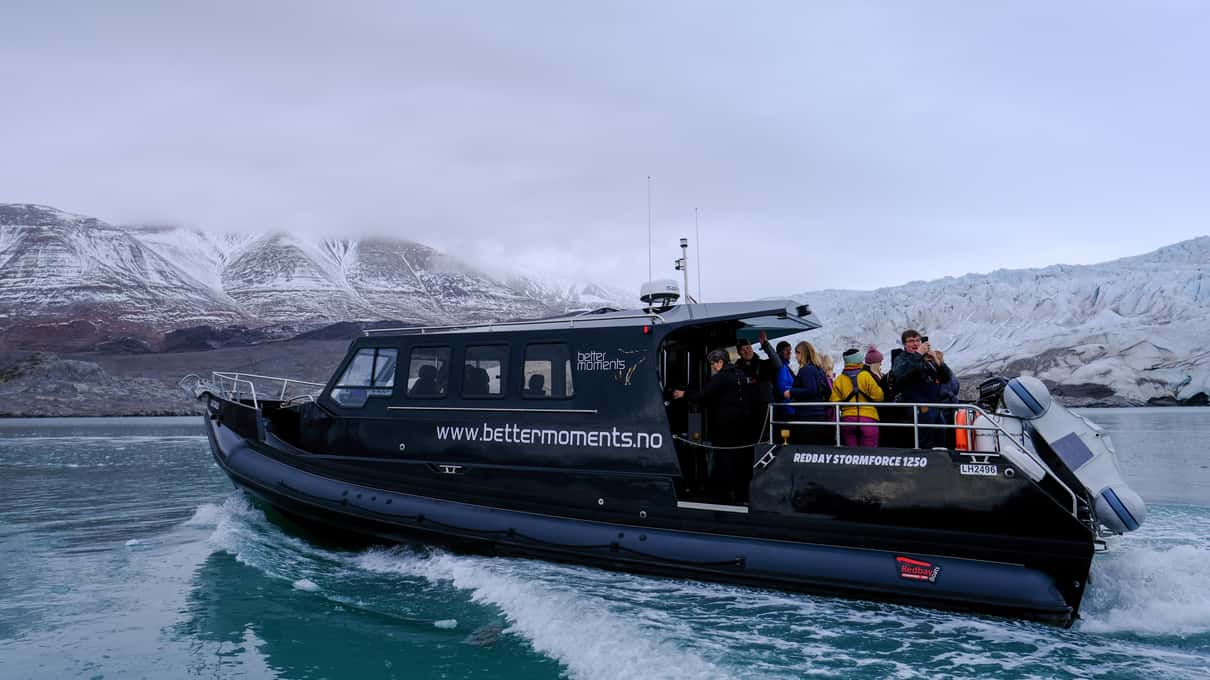
The view sits lower than on a big boat and the cabin keeps you warm between sightings, which makes this a gentler version of the small-boat experience. The catch is the long bus day and a higher fare; our small-group guide sets the headcounts side by side.
Rough water and each hull
No boat removes seasickness. Big boats tend to feel the swell less, though a catamaran can still roll when the sea runs high. A RIB bounces and slaps through every wave. Skua's covered boat is small, so it moves more than a big hull. Rødne keeps tablets on board for guests who need them.
Polar goes further and warns off anyone who gets seasick easily. When wind or waves are too strong, the operator cancels the sailing and either rebooks or refunds you; our page on cancelled and empty days walks through it.
Which boat for which traveler
- Brim suits wheelchair users and families with strollers, going by its Viator listing
- Rødne suits anyone who wants a warm lounge and the longest time in the whale area of the big boats
- Polar Adventures suits travelers who want lunch included and a moderate crowd
- The RIB suits photographers who want a low angle and can handle cold spray
- Skua Nature suits those who want a small group without the cold, and a guide who talks them through what they see
- Tight budgets point to the two big boats, which also ask the least of your wardrobe (see what to wear)
The fares sit side by side in what an orca tour costs. If you are torn between two shapes, think about the bus.
An early start and about eight hours on the road buy you the small boats; skipping them means a bigger crowd but a shorter, warmer day that starts after breakfast.