How orcas hunt the winter herring
The orcas near Tromsø are there for one reason, and it swims in schools of millions. Once you know how the herring ties the orcas to the humpbacks, a grey winter fjord becomes much easier to read. This guide covers what the animals do, what you can expect to see from the deck, and how close the boats are allowed to go.
The largest dolphin in the fjord
An orca is a dolphin, the largest member of that family, although many visitors grew up calling it a killer whale. The black back and the white patch behind the eye stand out even in the flat blue light of a northern winter.
Adult males carry a straight dorsal fin that can reach about 1.8 m (6 ft), tall enough to pick out far across the water. Females and young animals have a shorter, curved fin. When a guide calls out a male, look for that upright black blade first and the rest of the animal second.
The orcas you meet on a trip from Tromsø are not passing by at random. They travel in family groups, so you usually see several fins of different heights rising close together, and they come north for food. In northern Norway in winter, that food is herring.
Why the herring brings them
The Norwegian spring-spawning herring spends the winter packed into enormous schools in sheltered northern fjords, and the whales follow it in. In recent winters those schools have gathered in the fjords around Skjervøy, north-east of Tromsø, which is why every boat on this site makes a long run north.
The herring keeps no fixed address. In earlier winters it lay much closer to Tromsø, and it may move again. Our guide to why the boats head for Skjervøy covers the route, and the best weeks to go track the same fish.
Carousel feeding, the orcas' method
In Norway, orca pods tend to hunt herring as a team. A pod circles a school and herds the fish into a tight ball near the surface, then individual orcas slap the edge of the ball with their tails to stun the fish and pick them off one at a time.
Researchers call this carousel feeding. From a boat it can look like confusion, with fins turning in a ring and white bursts of water while gulls drop onto the scraps.
You will not always see the hunt itself. Much of it happens below the surface, and on many trips the orcas are travelling or resting between meals.
Neither orcas nor humpbacks are ever guaranteed, and the weather can cut a day short as well. If the sea or the whales let you down, what happens when you see no orcas explains the retry offers and the small print.
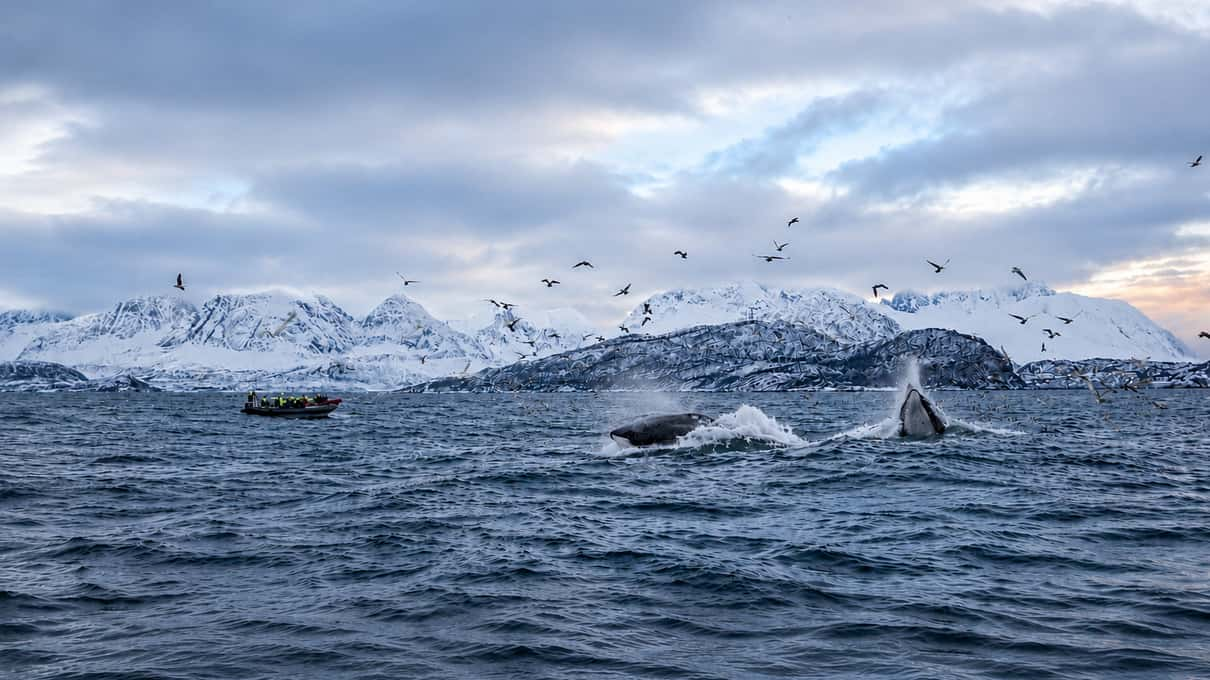
Humpbacks at the same schools
From about November, humpback whales feed on the same herring as the orcas, but in their own way. A humpback lunges up through a school with its mouth wide open, takes in a huge gulp of water and fish, and lets the water drain out through its baleen.
Seabirds gather where the herring is pushed toward the surface, so a cloud of gulls on the horizon is often the first sign a guide looks for. Humpbacks are not promised either, although in a good week they can outnumber the orcas.
Now and then a long, fast fin whale turns up, showing little more than a tall blow and a slim grey back. White-tailed eagles live along this coast all year, and on the long run north you may spot one perched on a rock or circling over the water.
More time with the whales, lunch included
Polar Adventures sails from the front pier with no more than 50 guests on an 8-hour day, from ~$269. Thermal suits come with the fare along with lunch and hot drinks, and the crew budgets 2–2.5 hours near the whales if the sea allows. Free cancellation up to 24 hours ahead.
What you see and hear from the deck
Most of the time an orca is a fin and a blow. Black triangles roll up and slide under, a short puff of spray hangs in the cold air, and then the pod disappears for a minute or two before it surfaces somewhere else.
A tail slap shows as a white burst on the water. Once in a while an orca or a humpback breaches, throwing most of its body clear before crashing back, but treat that as a bonus and not as part of the plan.
Listen too. On a still day the blows carry a long way, a sharp exhale from an orca and a deeper, longer rush from a humpback, and you hear them best when the boat slows right down near the whales.
Light is short in the polar night, so photos tend to come out grey-blue and grainy, and your own eyes often beat the camera. You will stand still at the rail for long spells, so read what to wear on an orca safari before you pack.
How close the boats go
Expect distance, not contact. Near the whales the boats slow down or switch off and keep their distance, and the animals decide how close they come. Brim Explorer's boats switch to a quiet electric motor around the whales, which cuts engine noise in the water.
Rødne Fjord Cruise points to its Eco-Lighthouse certification and to the AECO and Visit Tromsø guidelines for whale watching. No listing promises a close encounter, and neither do we.
Sometimes an orca surfaces beside the hull anyway. On a RIB you sit nearly at water level, which makes even a fin some way off feel near, at the price of cold spray and a 12-hour day. Our guide to the boat types sets the shapes side by side.
Watching, not swimming
In Norway it is not allowed to swim with orcas from these tours, and none of the six trips we compare puts anyone in the water.
You watch from the boat, wrapped up, with a guide explaining what the pod is doing. That suits the animals and, in water this cold, it suits you as well.
Choosing a boat for watching behaviour
If seeing how the whales feed matters more to you than the price, compare the time each trip spends in the whale area. Polar Adventures aims for about 2–2.5 hours there. Rødne's catamaran, from ~$225, plans about 2.5 hours, while Brim Explorer, from ~$224, gives about 1–1.5 hours after a crossing of 3–3.5 hours.
The bus days to Skjervøy give about 3 hours on the water, and Skua Nature's heated boat, from ~$353, adds a nature guide for a group of up to 12.
The size of the group shapes the experience as well, since fifty people share a rail more easily than a hundred. Our guide to small-group orca tours weighs that against the longer days and higher prices of the smaller boats.