The best time to see orcas near Tromsø
The orcas come to the fjords north of Tromsø for the herring alone, and the boats only sail while the fish stay. That gives you a window of roughly three months in the darkest part of the year. Pick your week with the light and the weather in mind, and leave a spare day for a second go.
The herring sets the calendar
Norway's orcas follow the Norwegian spring-spawning herring, a huge stock that spends the winter in the northern fjords before heading south to spawn.
In recent winters the fish have gathered in the fjords around Skjervøy, a few hours by boat from Tromsø, and the orcas and humpbacks come with them. Once the herring leaves, the whales follow it out and the tour boats stop sailing. Why the boats go so far north is the subject of our guide to the run to Skjervøy.
Most operators sail from late October to the end of January. A few keep going into February, but the listings we compare on this site end with January.
The herring also shifts from one winter to the next, so the whale area can sit closer to or farther from Tromsø than it did the year before. Nobody can tell you in summer exactly where the fish will settle.
Three stretches of the season
Think of the season in three parts, each with its own trade-off.
- Late October to mid-November: the most daylight of the season, a few hours of low sun, and fewer visitors. The herring is still arriving, so whale numbers can be patchier
- Mid-November to mid-December: often the steadiest weeks for orcas, with humpbacks feeding on the same schools from about November. The sun disappears toward the end of November
- Late December into January: whales are usually still around and the polar night is at its deepest. The Christmas and New Year rush fills boats and hotels
If we had to name one stretch, it would be mid-November into January, which is usually treated as the core of the season. That is a tendency and no more. Orcas are never guaranteed on any trip, and neither are humpbacks, in any week.
Living with the polar night
From about late November to mid-January the sun stays below the horizon in Tromsø, a stretch called the polar night. It is not pitch black all day.
Around midday you get a few hours of twilight that starts blue and turns pink and orange along the southern sky, and on a clear day the snowy peaks glow. The whale boats are timed to spend those hours in the whale area, so you leave Tromsø in the dark and come back in the dark.
For photos, that low light is both a gift and a problem. The colors are soft and unusual, but shutter speeds drop. A moving fin in grey water is hard to freeze.
A phone does better than you might expect in twilight, though a camera with a fast lens helps more. The weeks in late October and early November give you real sunlight on the water, which suits anyone who cares most about sharp pictures.
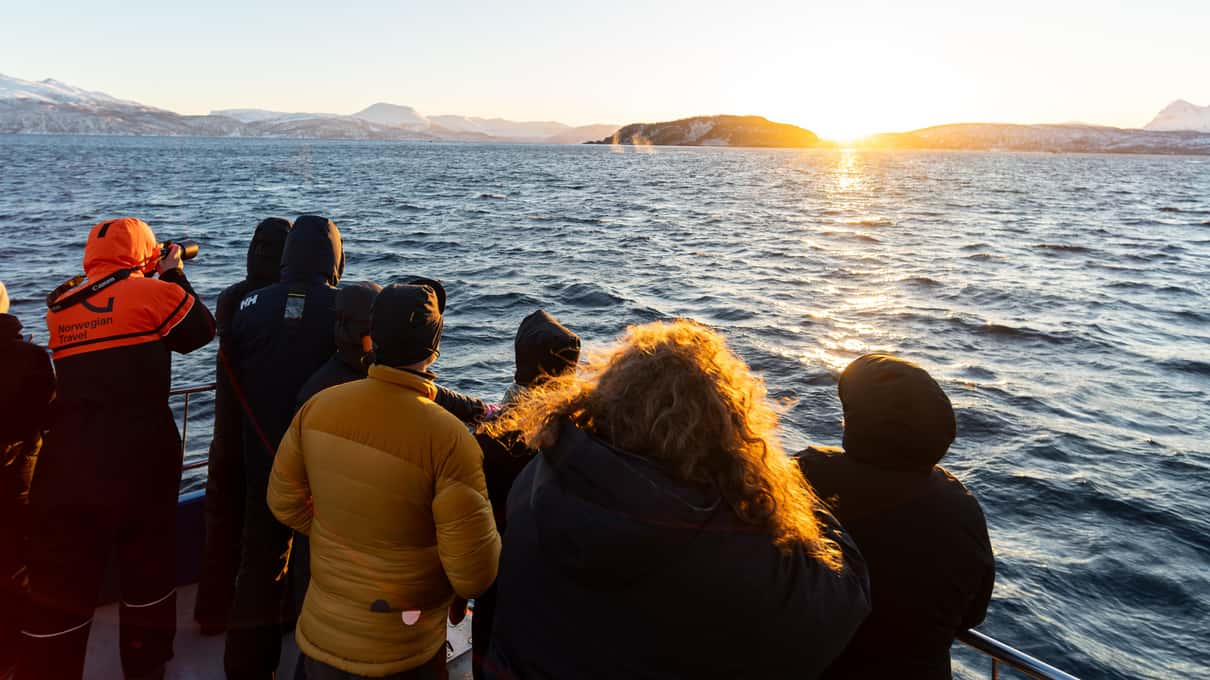
Rødne's season on the high-speed catamaran
Rødne Fjord Cruise's catamaran day, from ~$225, runs across the whole window, from late October to the end of January.
It sails at 08:30 on MS Rygerdronningen, and from early December a second departure at 09:00 on MS Rygertroll is added, which makes December the easiest month to find a seat. The trip lasts about 8 hours, with roughly 2.5 hours in the whale area. It holds 4.7 from 3,700+ reviews on GetYourGuide.
A catamaran that sails the whole season
Rødne leaves from the harbor behind the Nerstranda shopping center, and the crew hands out seasickness tablets in the warm lounge. If you see no whales, the listing offers a free second trip through the Destination Tromsø booking point, subject to space. From ~$225, with free cancellation up to 24 hours ahead.
The catch is the size. Up to 100 people share the boat, and food is for sale rather than included. Our comparison of boat types sets it against the smaller boats.
Storms and cancelled days
Winter in northern Norway brings low pressure systems one after another, and the open stretches on the way to Skjervøy can get rough. Operators cancel when wind or sea state makes the trip unsafe, and that happens more often during stormy spells.
Daytime temperatures usually sit a few degrees below freezing, around −2 to −4 °C (25–28 °F), but wind at sea makes it feel far colder, so plan your layers with our clothing guide.
A cancellation by the operator brings a full refund or a new date. What it cannot give you back is time. If your boat is booked for your last morning in town, a storm leaves you with nothing.
Our page on what happens with no orcas or a cancelled boat covers the options in more detail.
Booking ahead for Christmas and New Year
The weeks around Christmas and New Year are the busiest of the winter in Tromsø. Hotels fill up, and the popular whale departures can sell out days ahead. If those are your dates, book the boat when you book the flight.
All six tours on this site let you reserve now and pay later on GetYourGuide, with free cancellation up to 24 hours before, so an early booking costs you little flexibility. Our price comparison lists what each one charges.
Book your whale day for the first or second day of the trip. If the weather cancels it or the whales stay away, you still have days left for a second try.
A night at sea instead of a day trip
One more option stretches the timing question. Arctic Resorts' 24-hour expedition on MV Quest, from ~$698, keeps you near the whale area overnight in a private cabin, which gives you whale time on two days with a night in between for the aurora.
The catch is that a night at sea still does not promise whales or lights, and it costs about twice as much as the day boats, with fewer than 50 reviews on GetYourGuide so far. If you want both sights on one trip, read our guide to orcas and the northern lights first.